

When we started building Amera, we didn't expect our physical mailroom to become one of the parts of our product that customers cared about most.
While we knew paper claims were still a reality for TPAs and health plans, we underestimated the operational overhead they create and how difficult it is to fully automate turning an envelope into a claim ready for adjudication.
An estimated 190 million medical claims are still mailed every year. Although that's only about 2% of total claim volume, it's still a lot of paper.
Each claim envelope must be received, opened, scanned, identified, separated from supporting documents, converted into structured claim data, validated, and delivered to the right downstream system. The original documents also need secure storage and eventual shredding.
Over the past two years, we've built Amera's mailroom to handle that entire process. As our volume has grown, we're now opening multiple facilities to process paper claims for TPAs.
This post explains what happens inside that process, from the moment an envelope arrives to when a claim is ready to enter a TPA's claims system.
Why are there so many paper claims?
When paper claims started coming into our facility, we made a point of calling provider offices and billing companies to ask why they were mailing claims. In most cases, mailing a claim is more expensive and cumbersome than submitting it electronically, so why are clinics and hospitals doing it?
One of the most common answers was that they had already tried to submit the claim electronically, sometimes several times. The claim failed somewhere in the process, and the provider received an error message that wasn't specific enough to easily resolve. At that point, printing the claim and mailing it directly to the payer was often the easiest way to get it through.
Attachments are another common reason. Some claims must be submitted with an EOB, medical records, an itemized bill, a repricing sheet, or other supporting documentation. Not every electronic submission path can accommodate these documents.
We've also spoken with providers that must submit on paper because the TPA doesn't accept electronic claims. In other cases, a network collects claims from its providers electronically but doesn't have an electronic connection to the TPA, so the network prints the claims and mails them.
There isn't one reason paper claims still exist. In many cases, paper is the fallback when the electronic path between a provider and a payer doesn't work.
What does Amera’s mailroom do?
The physical part of the mailroom work is relatively straightforward. We mail paper claims directly to an Amera facility. When an envelope arrives, we open it, scan everything inside, and securely store the original documents for 30 days before shredding them.
The more complicated part starts after we scan the envelope.
First, we figure out what we received. An envelope might contain a single CMS-1500 or UB-04. Still, it might also contain several claims, an EOB, medical records, an itemized bill, a repricing sheet, a check, or some combination of those documents. A single claim can span multiple pages, while one envelope can contain claims for multiple patients.
Before we can extract any claim data, we have to identify each document, determine which pages belong together, and associate supporting documents with the correct claim.
Once we've identified a claim, we extract the data and validate key information, including provider identifiers such as TIN and NPI, member information, and required claim fields. Anything our system isn't confident about is sent to a person for review rather than guessed.
From there, claims that pass the required validations are converted into the appropriate electronic format, such as an 837P, 837I, or 837D, and delivered to the client. We maintain traceability back to the original scanned documents so the electronic claim can always be tied back to what arrived in the mail.
Documents that aren't claims follow separate workflows. EOBs, checks, returned mail, repricing sheets, and other documents can each be routed according to the client's requirements.
What makes a mailroom operation so complex?
No two envelopes are the same. We get handwritten claims. We get faxed copies of copies and black-and-white photocopies of forms designed to be read in red ink. Sometimes one envelope contains multiple claims, and sometimes a single claim arrives across several pages or documents.
Corrected claims can be mixed in with originals, and some claims get mailed to the wrong payer entirely. Supporting documents like medical records, itemized bills, and repricing sheets have to be identified correctly and kept with the right claim.
On top of that, every client requires specialized processes. Where an EOB should be routed, what to do when a required field is missing, how to handle a repricing sheet, or when something should be rejected versus reviewed versus defaulted. None of those instructions are written on the form we receive in the mail.
How does technology (including AI) make this process more efficient?
Reading a form is actually one of the less complicated parts of the problem. OCR and AI models can pull data from a clean CMS-1500 reliably, but it still took our team significant work to meet the quality bar we needed.
We spend much more of our time on the connective tissue (orchestration, if you want to be fancy): determining which pages belong to which claim, keeping attachments with the right claim, validating the extracted data, applying client-specific rules, and deciding when something can move forward automatically versus when it needs human review.
The goal isn't to use AI to make every decision. It's to automate the parts of the process that can be handled reliably and make it very clear when a person needs to step in.
Some of this complexity can be standardized across clients. Some of it comes from differences in contracts, workflows, and downstream systems. Our job is to build those differences into the system once so an operations team isn't rediscovering them claim by claim.
Building for new plan designs
Paper claims are one example of a broader healthcare challenge: the data needed to process a claim doesn't always arrive in the same format or follow the same path.
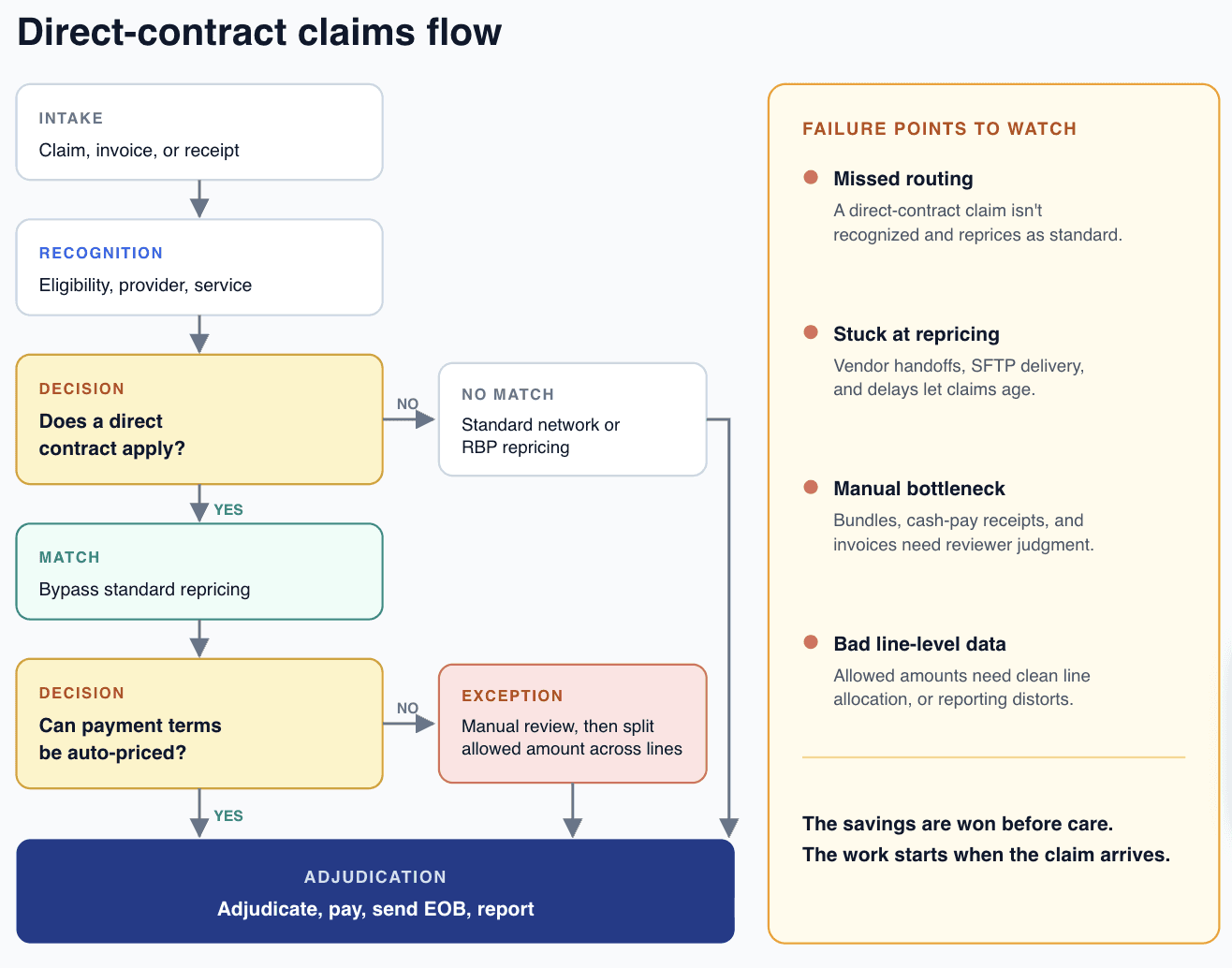
That variation is only increasing. New plan designs use direct contracts, reference-based pricing, bundled rates, specialty networks, and other arrangements that can change how claims are routed, priced, or supported. The underlying data may arrive as an 837, a paper claim, an EOB, a repricing sheet, an itemized bill, or some combination of them.
At Amera, we're building the infrastructure to handle that variation. The goal is to take claims and supporting information in whatever form they arrive, apply the appropriate workflow, and turn them into consistent, structured claim data that a TPA's downstream systems can use.
Paper claims aren't going anywhere soon. Neither is the variation in how healthcare gets paid for - in fact, we expect variation to increase as plan designs get more complex. The infrastructure should handle both.
Download the high-resolution PDF of our TPA Ecosystem Map